
Unlocking the potential of machine learning for peptide predictive and generative modeling
Goran Mousa
University of Rijeka (Croatia)
CFM Auditorium
Team Colloquia CFM
Dr. Ruben Pellizer
Dr. Ignacio Piquero
Dr. Ivan Sasselli
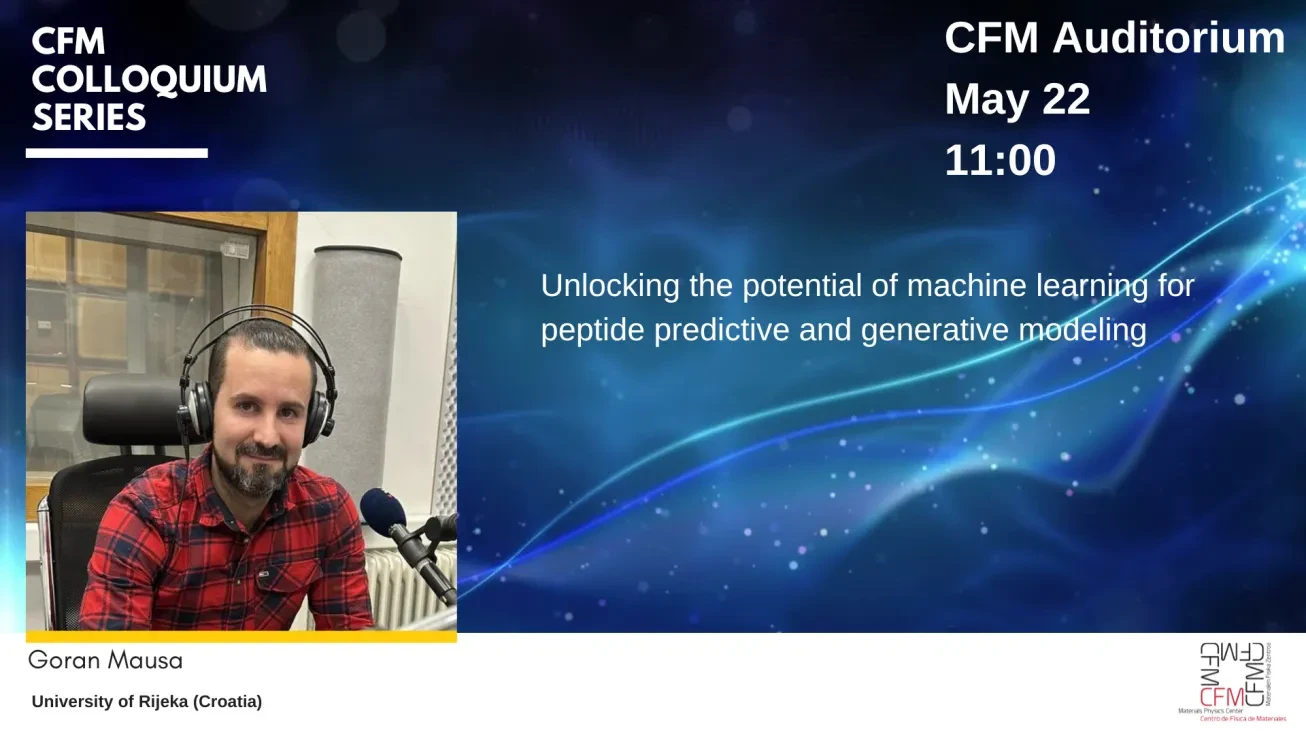
Deep learning is emerging as a powerful approach for addressing challenges in peptide chemistry, where complex sequence–function relationships and vast combinatorial sequence spaces complicate rational design. However, its application is often hindered by concerns regarding model reliability, data representation, generalizability, and the limited size of available peptide datasets. The presented work demonstrates that robust predictive models can be developed even from relatively small peptide datasets and that suitable sequence representations enable effective transfer learning from proteins or even small molecules. In addition to predictive modeling, a configurable generative framework combining genetic algorithms with machine-learning-based fitness functions enables the discovery of novel peptides with targeted functional properties. Together, these approaches illustrate how data-driven methods can accelerate peptide discovery and expand exploration of functional peptide chemical space.