
Newsroom
News
Even or odd numbers: a single molecule makes all the difference in the quantum world
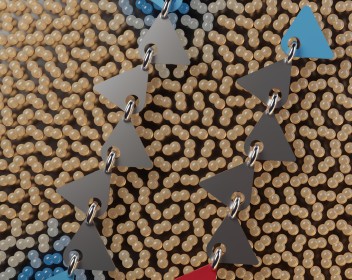
The researchers in the Quantum Detection Microscopy group at CIC nanoGUNE, in collaboration with chemists at CiQUS of the University of Santiago de Compostela, have demonstrated that adding or removing a single molecule from a quantum chain can fundamentally change its interaction with a superconductor. The key lies in a property as simple as parity, that is, whether the chain contains an even or odd number of units. While chains with an odd number interact magnetically with the superconductor, those with an even number do not. The results of this study have been published in the prestigious journal Nature.
MIRA 2026, a window to medical microrobotics
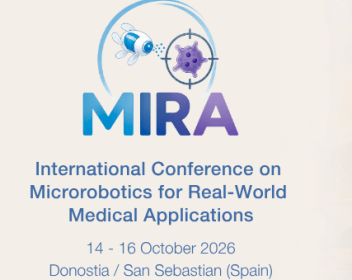
From 14 to 16 October, the San Sebastian Aquarium is hosting the MIRA 2026, International Conference on Microrobotics for Real-World Medical Applications, which is aimed at promoting innovation, strengthening translational research and accelerating the development and adoption of microrobotic solutions for critical medical needs.
nanoGUNE receives representatives from the Governments of Catalonia
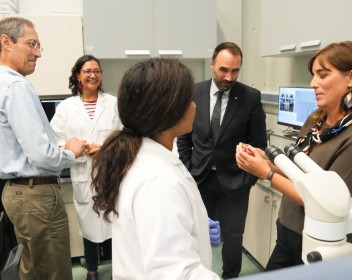
Today, nanoGUNE welcomed a delegation from the Generalitat de Catalunya, led by Núria Montserrat, Minister for Research and Universities of Catalonia, and accompanied by representatives from the Basque Government.
The IKUR community comes together at CIC nanoGUNE
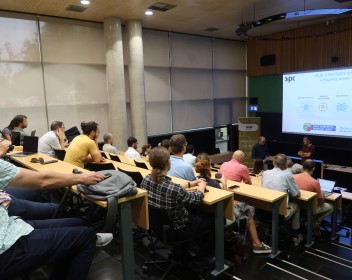
On 15 and 17 July, the IKUR research community organised two working sessions at nanoGUNE, aimed at sharing knowledge and advances and strengthening the collaboration between the IKUR Quantum Technologies and IKUR HPC−AI projects. The sessions had the participation of representatives from the Basque Government’s Department of Science, Universities and Innovation: Adolfo Morais, Deputy Minister for Science and Innovation, Amaia Esquisabel, Head of Science Policy and Maialen Agirre, Head of Innovation.
CIC nanoGUNE has been awarded the María de Maeztu Unit of Excellence for the third consecutive time
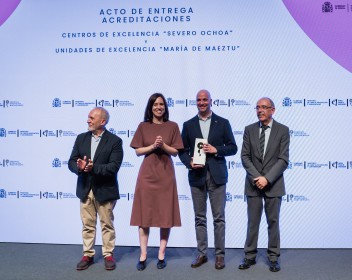
CIC nanoGUNE received its third María de Maeztu Unit of Excellence accreditation at an official ceremony in the Cubo Azul Auditorium of the Polytechnic University of Valencia, organised by the Ministry of Science, Innovation and Universities to recognise the research centres and units selected in the 2025 call. Representing nanoGUNE were its director José María Pitarke, and lead researcher Luis Hueso, who received the accreditation statuette that reaffirms the centre’s position as an international leader in the fields of nanoscience and nanotechnology.
Purely Dynamic Skyrmion Phase discovered
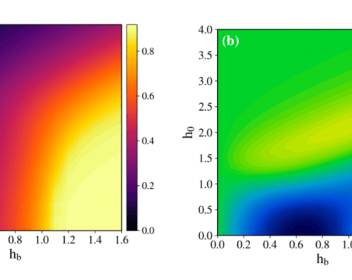
In a recent article published in Physical Review Letters (Phys. Rev. Lett. 137, 026703 (2026)), a collaboration of scientists from Turkey, the UK and the Nanomagnetism group at nanoGUNE have discovered a non-equilibrium skyrmion phase that has no equilibrium equivalent but is instead fundamentally associated with the oscillating magnetic fields that are driving the non-equilibrium dynamics in two-dimensional lattice systems.
A new ultra-compact sensor paves the way for more powerful and scalable silicon quantum processors
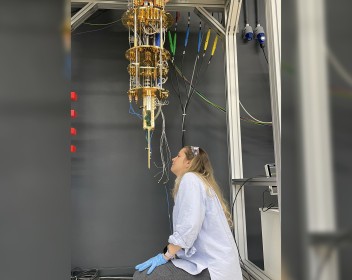
Researchers from the Quantum Hardware group at CIC nanoGUNE, in collaboration with the British company Quantum Motion, have demonstrated an advanced readout sensor for spin qubits that, while being more compact that previous designs, can reach the level of readout precision needed to implement quantum error correction protocols. The study has been published in the journal Nature Sensors.
TextaDNA project advances DNA based data storage using polymer fibers
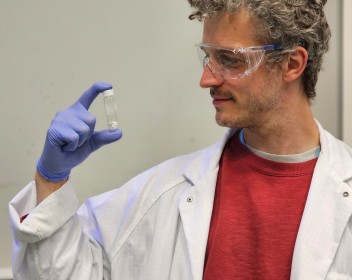
The TextaDNA project, funded by the EIC Pathfinder program and coordinated by CIC nanoGUNE, is moving steadily forward in its mission to develop a new generation of DNA‑based data storage integrated into polymer fibers. In collaboration with Eurofins Genomics, a multinational specialized in DNA synthesis and sequencing located in Germany, the consortium is building a complete workflow that enables digital information to be encoded into DNA sequences, embedded into polymer‑based nanomaterials, and later retrieved and decoded with high fidelity.
Quantum and classical computing: the partnership accelerating the future
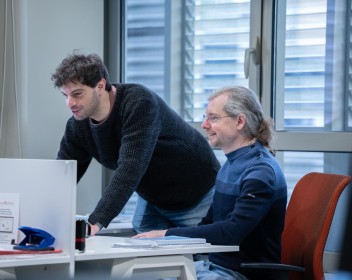
This new CIC nanoGUNE project involves adapting the SIESTA program, one of the most widespread codes for exploring how materials behave at the nanoscale, to hybrid workflows incorporating classical and quantum computing. This hybridization of SIESTA with the quantum computer will enable the scientific community to use IBM-Basque Country in a more accessible and broader way.
Industry, institutions, and research converge in San Sebastian to advance quantum readiness
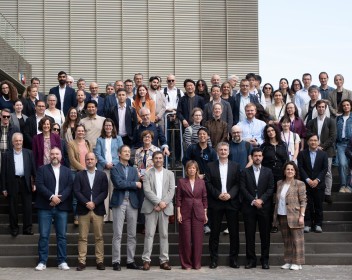
More than 100 international stakeholders explore the path from quantum research to industrial application within the Basque ecosystem. The Quantum Readiness for Business event showcases the Basque strategy, cutting-edge infrastructure, and collaboration opportunities in quantum technologies.